
The complete guide
How To Choose A Fly Swatter That Actually Works
The small problem that ruins a good evening
One fly. That is all it takes. The door was open for ten seconds while you brought the shopping in, and now something is doing laps of the kitchen light and landing on the fruit bowl. You wave at it. It leaves. It comes back.
Most people reach for a spray first, then regret it. The smell hangs around, you cannot use it freely near food or a pet bowl, and you end up wiping down a counter you had just cleaned. Traps are useful, but they work on their own schedule, not yours. For a single fly in a single room, the fastest tool is still a swatter, and it has been for a very long time because the physics are simple and nothing about it has to be charged, refilled or replaced.
The catch is that a swatter only helps if you can find one. That is the honest reason a three-pack beats a single. Most households own one swatter, it lives in a drawer in the wrong room, and by the time you have found it the fly has settled somewhere unreachable.
How a swatter actually kills a fly
It is worth understanding, because it changes what you look for.
A fly sees movement as changes in light and shadow, and it reacts fast. It also pushes off backwards and upwards when it takes off. Two things beat that. The first is air. A solid paddle pushes a cushion of air ahead of it, and the fly feels that wall of pressure before the paddle arrives. That is why good swatters have a mesh or slotted head: air passes through instead of warning the insect.
The second is reach. The further your hand is from the fly, the less of your own movement it registers in the moments before the strike. A 17.5 inch swatter like this one puts a decent distance between your arm and the target. That is also why a long handle fly swatter feels easier to use on a ceiling or a high window.
Flex matters too. A head that gives slightly on impact follows the contour of whatever it lands on, so the strike finishes rather than glancing away. A rigid paddle on a curved surface, say the side of a kettle or a window frame, often just bounces. The flexible head in this set is doing that job.
What to look for when you compare swatters
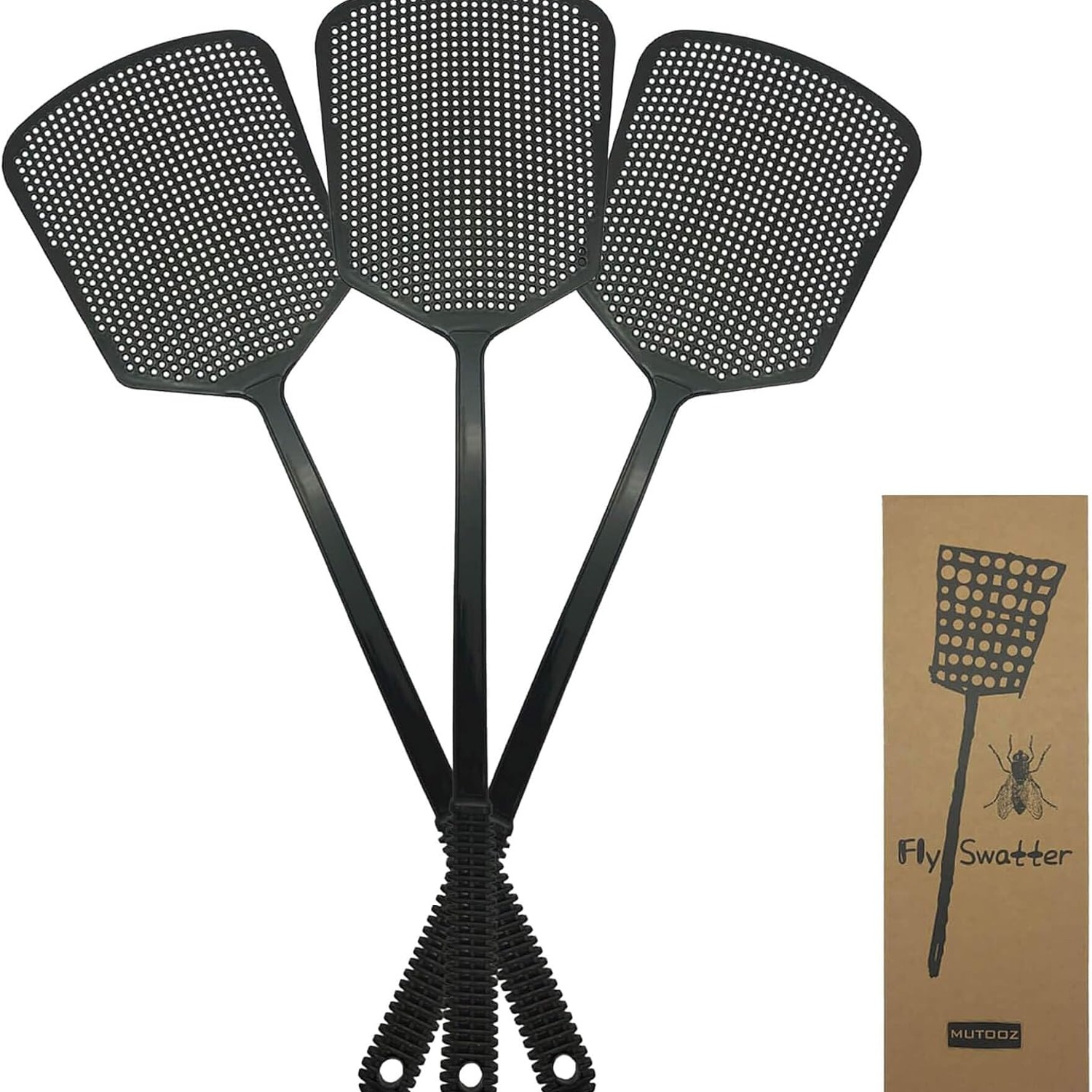
Length. Anything under about a foot has you leaning right over the fly. These are 17.5 inches, which is a comfortable middle ground: long enough for reach, short enough that it does not catch on cupboards when you swing in a small kitchen.
Head size. A wider head forgives a slightly inaccurate swing. The 4.9 inch head here is generous. On a narrow head you have to be precise, and precision is hard when you are tracking a moving target.
Handle thickness. Thin, flat handles twist in your fingers and your grip slips at the worst moment. A thicker grip section keeps the head aimed where you pointed it. It also matters if you are swatting repeatedly on a warm evening with the back door open.
Material. Plastic is the standard for a reason. It is light, it washes clean, and it does not rust if it ends up outside on a damp table overnight. Wire-handled swatters can last longer but they are heavier to swing and can bend out of true.
Quantity. This is the underrated one. One swatter is a hunt. Three is a system.
Who this set suits
Households with a back door that stays open in summer. If you have a garden, a dog flap, a compost bin near the kitchen, or a barbecue that gets used weekly, flies are not an occasional visitor.
Anyone who eats outdoors. A patio table, a picnic bench or a caravan awning attracts flies faster than an indoor room, because food smells travel. Keeping an outdoor fly swatter permanently outside is far easier than carrying one back and forth.
People who travel light. Campers, caravanners, van lifers and festival goers all deal with insects, and none of them want to carry an appliance. A half-inch thick plastic swatter weighs almost nothing and needs no power.
Small businesses. Cafes, workshops, garden centres, classrooms and stables often need a swatter in more than one place. Three units covers three areas, and because they are cheap enough to treat as a consumable, nobody panics if one gets left outside.
Households that avoid chemicals. If you have small children, a cat, a bird or a fish tank, spraying insecticide indoors is a genuine hassle. A manual fly swatter uses nothing at all.
Using one well
A few habits make a big difference.
Wait for the fly to land. Swatting at a fly in flight almost never works, because it can change direction faster than your arm can. Let it settle on a flat surface and take your shot then.
Approach slowly, then swing fast. The slow approach keeps you out of its warning range. The fast swing beats its reaction time.
Aim slightly behind and above where it is sitting, because that is the direction it launches in. On a flat wall or window, a straight-on strike works fine.
Pick your surfaces. Flat, firm, washable surfaces are ideal. Avoid swinging at a fly sitting on a lampshade, a screen, a TV, glassware or a houseplant you care about. Wait for it to move.
Clean up afterwards. Wipe the surface and rinse the swatter head. It takes ten seconds and keeps the tool fit for a kitchen drawer.
Looking after them
Care is barely a chore here, but a small amount of it doubles the life of a plastic swatter.
Wash the head with a damp cloth and a little dish soap after any messy strike, then rinse and let it dry fully before it goes back in a drawer. Do not put it through a dishwasher, since the heat can warp thin plastic and leave the head twisted.
Keep them away from heat sources. A swatter left on a hot barbecue lid, a radiator or a dashboard in strong sun can soften and lose its shape. The same goes for long-term storage in full sunlight, which makes plastic brittle over time.
Store them flat or hanging by the handle. The weak point on any swatter is the join where the head meets the handle, so avoid bending the head back on itself or using it as a lever to reach things.
If one does eventually give out, that is exactly why the pack has three.
The short version
This is a straightforward set of three black plastic fly swatters, 17.5 inches long with a 4.9 inch head, manual, flexible, and listed for both indoor and outdoor use. There is nothing clever about it, and that is the point. It does not need batteries, it does not smell, it costs nothing to use, and it works the moment you pick it up.
The reason to buy three rather than one is purely practical. Put one in the kitchen, one by the door you actually use, and one in the car, the shed or the camping box. The next time a fly comes in, you will not spend five minutes looking for the swatter while it does another lap of the ceiling.